Thomas More
Wolf HallThomas More is a lawyer, scholar, and Lord Chancellor whose defense of the Church’s authority becomes a direct challenge to the crown’s claim to govern religious affairs in England. In the novel, his conflict with Thomas Cromwell is not simply a contest between two powerful men: it turns on whether Parliament can legislate only temporal matters or also spiritual jurisdiction, and on what a subject owes to conscience when the king demands political obedience.
Identity and Position
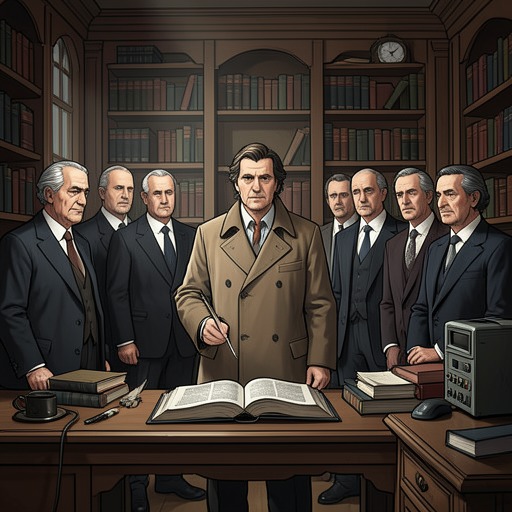
At Chelsea, More is a lawyer and scholar who succeeds Thomas Wolsey as Lord Chancellor after Wolsey’s fall. He is widely revered in Europe, and the court recognizes his learning and standing even when it resents his opposition to the king’s marriage policy. In Cromwell’s eyes, he belongs to a different intellectual and moral world: the two men acknowledge one another, but their encounters leave Cromwell wondering why learning confirms More in his existing beliefs while steadily unsettling his own.
More’s public authority is grounded in scholarship and office, but the novel also depicts the disciplines by which he sustains his religious commitments. Cromwell knows that More wears a horsehair garment and uses a small scourge associated with religious orders. Rather than treating these practices as mere signs of piety, Cromwell wonders about the labor behind such instruments: who makes them, and how ordinary work becomes part of another person’s self-inflicted suffering. The thought connects More’s private discipline to the material world Cromwell habitually examines.
Learning, Faith, and the Reformation
The two men’s disagreement over religious change appears first as a difference in how they read. Cromwell asks where the Bible names purgatory, relics, monks, nuns, or the Pope; each month, he feels inherited certainties being chipped away. More, by contrast, seems to Cromwell to absorb new arguments without revising what he already believes. The contrast is not presented as a simple division between ignorance and knowledge: More is the celebrated scholar, while Cromwell is the one whose encounter with new texts is changing his mind.
More has collaborated with Henry VIII on a book against Martin Luther, for which the Pope granted the king the title Defender of the Faith. Although Cromwell and Wolsey also oppose Luther, Cromwell follows the flow of new writing, including works smuggled across the Channel and brought ashore through small coastal inlets. He keeps Wolsey informed, allowing the cardinal to respond to clerical alarms with the assurance that he already knows of the latest heresy. Wolsey burns books, but not people; at St Paul’s Cross, however, the destruction of printed English works gives the religious dispute a material and public form. Cromwell’s interest in the English New Testament associated with William Tyndale further sharpens the disagreement: he has a pirated Antwerp edition in a locked chest and hopes More might see its title page, which claims it was printed in Utopia.
More’s opposition to the king’s marriage case also places him against Cromwell’s political efforts. During the Blackfriars proceedings, Cromwell thinks of More as a star in another firmament and wonders whether the distance between them reflects a failing in More, in himself, or in the very different ways they respond to what they learn. Their separation is thus intellectual as well as political: More’s religious framework remains firm, while Cromwell increasingly tests the authority of its institutions against the language of Scripture and the interests of the crown.
Rival Claims to Legal Authority
The novel gives the conflict its clearest legal form in disputes over the source and limits of jurisdiction. When Katherine of Aragon and Mary challenge the king’s claim to be head of the Church in England, they invoke the Pope’s authority and the Church’s place in a wider Christian order. Cromwell answers that the king cannot simply be led, and argues that the formula limiting his authority to what the law of Christ allows preserves room for interpretation. In this political contest, the words of a legal formula matter because they can be redefined and applied differently as circumstances change.
Cromwell’s later account of Marsiglio of Padua’s propositions offers a contrasting theory of government. As Cromwell presents it to Henry, Christ came as a subject, not as an earthly ruler; priests therefore do not inherit a power to govern states from Christ. The prince governs citizens’ bodies and civil arrangements, while kingship derives through a legislative body acting on behalf of the people. The claims extend to marriage, legitimacy, church property, and taxation: Cromwell argues that these belong within the sphere of secular government and Parliament, rather than an authority based in Rome.
More’s distinction, reported by Richard Riche, is that Parliament can establish temporal jurisdiction but cannot exercise spiritual jurisdiction, which lies outside the realm. In a conversation framed as a series of hypothetical cases, More accepts that Parliament could make Riche king, but rejects the comparison with Parliament declaring God not to be God. For him, the king’s title and the spiritual authority of the Church do not belong to the same legal category. His refusal to treat Parliament’s naming of the king as head of the Church as decisive follows from that distinction; the issue is not simply whether a statute has been enacted, but whether the body enacting it has authority over the matter.
This distinction becomes politically dangerous because Cromwell is considering how More’s words might be used as evidence. He reasons that denying Parliament’s capacity in this matter could amount to denying the king’s title, and therefore to treason. Yet he also recognizes the difficulty: More has not plainly stated that conclusion, and might describe the exchange as informal argument. The reported conversation may be persuasive to a jury, Cromwell observes, but its meaning and intention remain contestable. The scene shows how a constitutional disagreement can be translated into a criminal charge through the interpretation of speech.
Political Conflict and the Question of Conscience
More’s opposition to the king’s marriage suit helps make him an unlikely choice for Lord Chancellor, yet Cromwell and George Cavendish predict that the king will appoint him. They agree that Henry may offer the office as a gesture and that More will accept, despite the conflict between his position and the king’s wishes. The episode presents More’s appointment as part of court politics, but also establishes the tension between public office and personal conviction that will define his later confrontation with the crown.
The power struggle reaches beyond the king’s immediate advisers. Cromwell’s efforts in Parliament include a division over suspending annates paid to Rome, which allows Henry to see who supports the measure and who opposes it. The king must then argue personally in the Lords, where members of old aristocratic families remain attached to Katherine and the Pope. These proceedings make visible the institutional conflict in which More’s position is situated: royal authority, parliamentary action, and church jurisdiction compete within the same political arena.
When Cromwell explains the proposed succession oath to Stephen Gardiner, he argues that Parliament’s decisions should not be dismissed as incapable of representing the commonwealth, nor displaced by Rome’s claim to a voice in England. The oath is intended to secure public assent to the succession arrangement, not merely to record a parliamentary vote. More’s position, as later related by Riche, exposes the point at which that strategy meets a limit: a subject may accept Parliament’s power over temporal government while refusing its authority over spiritual matters. The dispute is therefore both about succession and about which institution can demand an oath that binds conscience.
Characterization and Narrative Significance
More is chiefly seen through Cromwell’s wary, often ironic perspective. Cromwell can dismiss More’s account of the sack of Rome as exaggerated, and he resists claims that imperial troops roasted babies, reasoning instead that soldiers were occupied with taking valuables. But his skepticism does not make him indifferent to violence. His reflections on More’s hair garment and scourge lead him away from the spectacle of religious virtue and toward the workers whose labor supplies its instruments. More’s faith becomes, in Cromwell’s thought, inseparable from the ordinary people and material practices that sustain it.
The contrast between the two men also gives the novel a way to examine the consequences of changing religious authority without reducing the conflict to a contest between belief and unbelief. More’s steadfastness asserts that lawful political action has boundaries grounded in spiritual law; Cromwell’s political project asserts that the English crown and Parliament can define the limits of authority within the realm. Their disagreement is consequential because each claim is expressed through recognizable legal reasoning, while the state has the power to make its own interpretation enforceable.
More’s function in the narrative is thus larger than that of Cromwell’s antagonist. He makes visible the difference between an argument’s political usefulness and its standing in conscience. As Cromwell considers whether reported speech could sustain a treason charge, the novel shows a man’s carefully maintained boundary being examined as a matter of law and prosecuted as a matter of allegiance. The tension does not resolve into an easy verdict on either man: it leaves the reader with the central question of who may decide when the law of the realm and the law of the Church disagree.